Here is a list of things I like. I feel strange, compiling my list. Who cares? Who am I? But I really like reading lists of what other people like. And I really do like these things.
ORIGINS LIQUID LIP COLOR in Wild Flower. I tried my sister’s. Now I use it. My mom tried my sister’s. Now she uses it. If you wear lipgloss and you try it, you will use it. I am a sucker for makeup--even though I don’t really wear that much makeup and I certainly don’t wear it regularly. But I like having it around. Sometimes I get all dolled up, then I sit around the house or go to bed and take a nap. I like the hope and promise of makeup; it’s depressing and optimistic at the same time. I also like looking at makeup palettes. [I wrote this entire blog post spelling it as palate and had to change it--I always do that.] But it’s like painting with expensive paints. Once you are used to an expensive palette, you can’t go cheap. Well, you can but you’ll feel sorry for yourself.
Speaking of palettes.
OLD HOLLAND SINCE 1664. The palette is so beautiful and the tubes weigh a billion pounds more than other paints. If you pick one up, it’s like you’re picking up a bar of lead. Maybe you are, come to think of it. Are oil paints still made with lead? I’ll check right now . . .
Hmm. I guess so. Just came back from the website which says “Known as hazardous when worked with incorrectly. Occurs in the case of Cadmium pigments.” My husband is partial to Cadmiums, come to think of it. Also various Naples and Ochres and the Titanium white.
He keeps a narrow palette though. He feels distain for people with overly rangy palettes. (He would deny this but it’s true.) My husband allows my daughter to play with his Old Holland paints. He doesn’t let her finger paint with them or anything but she does paint with them on canvas. That’s probably not good. Oh well. There are worse things. We don’t give her whiskey and make her sleep in a drawer.
*Note: My husband read this and said, "I would like you to correct the part saying that I use Titanium White BECAUSE I HAVE NEVER USED TITANIUM WHITE. I USE FLAKE WHITE!"
EAST/WEST. My husband was commissioned to do a painting for our building. It was supposed to be a landscape of Chicago’s West Side.
As you see, it is not. Like many artists, my husband does not take direction well. He understands that you have desires, and he lets you express them, and then he says, “Okay.” And then he paints whatever he wants. Luckily, it's difficult for my husband to pick up on when people are pissed; he is missing that part of his brain. For this reason, he’s impervious to criticism. While he was working on the painting, he was three months late delivering it. One day he said, “I think X [client] may be pissed at me.” I said, “Why do you say that?” And he said, “Because he wrote me a email today that said something like, ‘Just get the goddamned painting done already and I’ll give you your little fucking wine and cheese party.’”
My husband looked at me and said, “I never even asked for a wine and cheese party. ’”
As you can imagine, when my husband was finally finished and he unveiled his painting of the west side, the client was . . .not overjoyed? My husband didn’t understand why anybody would be irritated about such a minor thing, and he refuses to be sorry for it.
His reasoning: “The landscape was not going well. So I did this instead. The perspective is facing east. But it’s reflecting west. The reflected buildings are on the west side.”
I said, “Of Michigan Avenue. To be fair, most people don’t really consider that ‘the west side.’”
He said, “Well, he wanted it done fast. That’s what he said at least. And this painting was coming together. I can’t help it if he doesn’t feel like it’s the west side.”
I was working on this fiction book that was based on real people and real events (though sequence was altered and physical characteristics and locations were changed), and I had all these worries and concerns in my mind about the real life people. About not hurting them, but still being able to tell the story. I was agonizing over it, turning over all the different options in my mind. I said, “It’s just that no matter what I do, somebody is going to be unhappy.” My husband said, “Somebody is already unhappy.”
TRADER JOE'S HOFBRAU BOCK. Kind of orange-y. Kind of grapefruit-y. Kind of high alcohol content. Very cheap.
EL TACO VELOZ. El Taco Veloz is my favorite Mexican restaurant in Chicago. And it is so cheap; it is the opposite of highway robbery. It’s like if you were on the highway and somebody drove up next to you and started throwing tortillas in your window.
Certain aspects of El Taco Veloz may annoy you or may delight you, based on your personality type. Obviously, I am the right personality type for ETV. We are a match, but here are some things to expect so you can judge for yourself if you are or are not an ETV person.
1.) The murals inside ETV are really weird. They’re supposed to be Mexican ladies, like “maidens” or something, holding baskets of fruit and vegetables, in white flouncy blouses, as if to say “I am abundant,” but the muralist must have thought that it would be better to give the Mexican ladies a splash of whiteness, and so all of the painted ladies have these giant creepy blue eyes like Barbie is peering out of them, watching you eat your barbacoa.
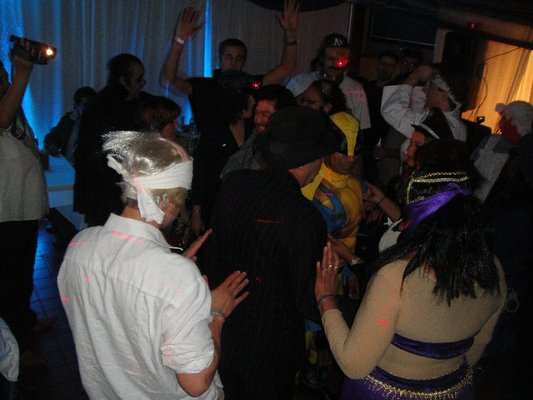
2.) The music is extremely loud and sometimes a birthday party happens in the middle of the restaurant without warning. There are booths around the perimeter and the staff starts moving chairs and tables aside and it just happens. David has been there before when they moved the chairs and people started dancing. His friend Mark—not the ETV personality type--was horrified. Mark is anti-jubilance. My advice: if you don’t like spontaneously appearing children in hats or adults dancing while you’re eating, skip ETV. These are, no kidding, pictures of ETV, possibly the night Mark and David were there.
3.) Instead of giving you bowls of salsa, they put the salsa into a squeeze container (like those plastic see through containers used to hold hair dye) and you have the squeeze the salsa onto each chip. If you ask for a bowl, they will bring it and you can squeeze some salsa into the bowl, thereby avoiding having to do the chip-by-chip squeeze. But you need to MAKE this happen, be assertive and innovative and all that.
4.) They have spicy pickled vegetables on the table, which are just out there, never put away, communal, there for the taking, which does not seem ALL that sanitary. But because of the high PH, I’m sure it’s fine—or fine enough; I eat them and I’m alive, let’s just say that.
Things that may bring you to ETV: Barbacoa. Cheese or chicken enchilladas (verde). Chilaquiles. Desserts: no. Don’t get the shrimp cocktail either.
P.S. Did you know that in Mexico a taco is not just a taco. A taco is anything wrapped in a tortilla. Did you know that taco in Spanish means wedge or plug or wadding; also pool cue? I didn’t. Taco, the word to describe the food, supposedly comes from a Náhuatl word derived from tlaxcalla which means tortilla.
What’s the diff between an electric kettle and a teapot? Well, electric kettles (this one) don’t get all gunky on the inside. And they heat water SO MUCH FASTER. I use a coffee press and I don’t like waiting forever for water to heat up in the morning. Also, I hate when tea kettles scream. I hate when people scream but it’s even worse when a machine screams--because you bought something that screams at you. This kettle has the friendliest “ding” too. Like the tiniest pleasing chime. I use this kettle 5, 6, 7 times a day…and have for five years. Mine seems to have a short. Sometimes the light flickers. When I see the light flickering, I get anxious. Don’t die. I suppose I should be anxious that it may catch on fire, but I’m not.
NESPRESSO. "What else?" I don’t have this. I WISH. My friend had one in Spain. I tried it and . . . it was all over. My vacation was over. I didn’t even leave the house after that. I just stood by the coffee maker all day. I was an unapologetic coffee-swilling PIG. I made myself like 15 cups (lungo! cups) of coffee a day. The coffee maker takes a little capsule. You throw it in this hatch and it punctures it somehow and the coffee pours out a spout into doubled walled glass. My daughter’s little friend’s mother has one and when I went to their place the first time to pick up my daughter, she said, “Coffee?” And I said, “I would, but husband’s making dinner. We should probably go.” When I walked in, the first thing my husband asked was, “Did she offer you coffee? I said, “Yeah, but I said I really shouldn’t, we had to get going.” “Oh,” he said. “You really should’ve. She has a Nespresso.”
The next time I went over, she said, “Coffee?” And I said, “Oh, I don’t know, you’re probably getting ready to make dinner. (Please insist!]” She did.
“I’ll just make you one! It’ll only take a minute. How do you like your cappuccino? Dry? Extra foam? Maybe just an espresso?”
Then she got out a billion capsules. She had an entire silverware drawer of them.
“Which kind do you want? This one’s good. And this one. This is a new kind; I haven’t tried it yet. My husband likes this one.” On and on.
When I looked down, her two-year old daughter was playing with a bunch of the capsules on the floor, stacking them and putting them in cups.
I said, “Capsules!”
She said, “Yeah, we didn’t like that kind at all.”
When the spout started spewing the coffee out, I said, “That thing is so SWEET. Mmm, mmm.” Then we talked about her coffee maker for a half an hour. During this time our children were coming up to us and trying to get our attention and we were like, JUST WAIT A SECOND WE ARE TALKING. Our conversation ended with her saying, “It changed my life. And I’m not just saying that.”
[And the MOST you’ll pay for it is $799 USD!]
Nespresso also has good commercials. John Malkovich is God, a piano falls on George Clooney, etc., etc.
This post started out as a list of my favorite things but it was becoming way too long and so a list of favorite things will come later.
But actually, I'll list one of my favorite things: Bumble and Bumble's Brilliantine.
This stuff is oil-based and you can’t slather it all over your hair or you’ll look like a rat and you’ll cry. Here’s how it describes itself: “Gives hair polish and a sort of languid, slept-in, sexy look.”
I am ready to run out of this stuff and I’m freaking out. How will my hair look sort of languid, slept-in, and sexy?!
I wish someone would make a perfume out of Brilliantine. (And the B & B Gentle Shampoo). I wish Elisa would smell this and write a column about it. I can’t begin to tell you how it smells. But I love it anyway.
In general, I do not like anything I can’t describe. It makes me uneasy. A friend of mine wrote a poem with a line in it "[. . .] description/all I ever wanted." Actually, I don't know if those are the exact words or the line break and I'm too lazy to look, but that's the gist and I am thumping my chest in agreement. Description is all I ever wanted too.
I really don’t like when I can’t describe the food I’m eating. I cannot fully enjoy any food I’m incapable of describing. When I’m eating it, I can only focus on classifying it, linking it to some like thing. I remember biting into an avocado when I was really young and trying to assign it to something. I remember thinking something equivalent to There is no making sense of this, this food right here in my mouth. How would you describe the taste of avocado? Nutty with a spritz of citrus? That’s what I’ve settled on, and I feel comfortable with that.
Tamarind is still indescribable for me.
I eat it, not because I like it, but because I cannot figure it out. And each time I eat it I think, This time will be different. This is the time my tongue is totally going to get to the bottom of this tamarind. But that never happens.
I just read a book--I’m not going to mention its title because it really doesn’t matter--and what was strange about it was that it was a memoir, and the subject matter of the book was implicitly emotional and charged, but the book itself was not. It had no voice whatsoever. It had no style that you could recognize. It seems nearly impossible to write a book with NO VOICE and NO STYLE but yet it has been done because I just read it.
This author is successful, too. She has several books of poetry published by a major house and a book of fiction by a major house. My friend who’s a journalist read it and she said the same thing, “It’s just so . . . bland. It’s like reporting.” I said, “Not even.” She said, “Yeah, not even. You’re right. The most remarkable thing about the book is how moving it should be, yet how unmoving and dull it is.”
Maybe because the author is first and foremost an important editor, she edited out her own style and voice? Or maybe she had to keep her voice agonizingly neutral to get through the subject matter? I have no idea. It was odd.
Another thing about the book is you couldn’t classify the people in it. In good books of fiction and non-fiction, the people/characters being described draw to mind real people or real kinds of people for the reader. Or they call up a composite of several real people or kinds of people. But that did not happen in this book. It wasn’t for lack of description. There was a ton of description. You knew the sister's hair was “blonde” and she had “skinny legs” because that was in the book and maybe she was “helpful” or “quiet” or whatever but you couldn’t FEEL any of that and you definitely couldn’t classify her, like Oh, just like my friend Jane. Well, I guess you could throw her into a pile of skinny-legged people, but . . . why?
Also the characters/people were discrepant. Their actions did not go with their emotions and in fact their actions did not go with their actions. That could make for a really interesting character, like “She’s quiet homebody who loves knitting. But she also loved surfing and really tying one on every Friday night! She was quirky like that.”
That’s not what was happening. It was like you kept trying to sniff out the scent of the person, and you couldn’t put your finger (nose) on it, but every once in a while, you’d get a faint whiff of something that MIGHT be a scent and later you’d get another faint whiff of something that MIGHT be a scent, but it was so faint you couldn’t be sure and anyway, the two things you thought were scents were so far from each other. It was like smelling cleaning fluid and hot dogs.
My friend always used to say about people, “She/he dresses with humor.” I knew immediately what she was talking about. Not like an “I’m with stupid” T-shirt or a beer can hat with hoses.
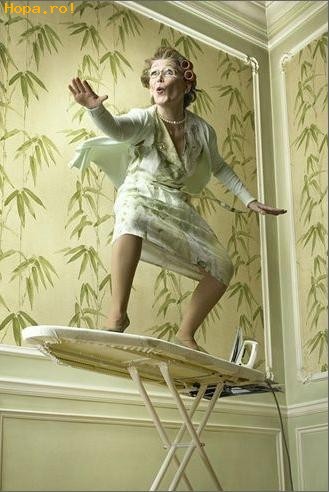
But just . . . with humor. *After just being asked for an example, I said: my sister. I hope she doesn't mind but I'm going to post a pic of her. She has it on Facebook anyway.
Here's another:
Note the kitty earrings? Are those kitties? Maybe robots? Oh, speaking of. Here's her Halloween costume:
This same friend who noted that people dressed with humor could not like people if she could not classify their clothes. She did not TRUST people if she couldn’t classify their clothes. She said (suspiciously), “It’s like you’re looking at his clothes thinking, 'Where did he even BUY that?'”
Again, we’re not talking about somebody wearing some pants made out of cellophane or a dress made out of dollar bills. We’re talking about somebody wearing pants that looked like they might have been from the 50s or something, something a math teacher might wear in the 50s, but they were never stylish then and they’re not stylish now, they don’t exemplify “50s style,” so there’s no way he got them from a vintage store and there’s no way he got them from a contemporary store because everything about them is dated and wrong for this century. So where did he get them?
Maybe this guy's uncle was a math teacher in the fifties and now the uncle is dead and this guy has him stored in his attic and every day he removes his decomposed uncle's pants and wears them? Then puts them back on his uncle at night? I suppose that is the most reasonable explanation.
I WOULD LIKE YOU TO TAKE THAT FULL-ON STAGE MAKEUP AND GORILLA SUIT OFF OF YOUR POEM; I THINK IT MIGHT LOOK BETTER JUST REGULAR
I read manuscripts for Switchback this year, like more than a hundred manuscripts for their contest, which was the most useful thing I've ever done for my writing. I saw thousands of perfectly proficient poems--good poems, even great ones--but after reading many of them, I wondered, "What is at stake here? Why must it be this writer who is writing this poem?" And most of all, "What’s with the full-on stage makeup and gorilla suit? We like you for who you are. But we can't see who you are. You don't need to be so ambitious and anxious."
Is this what you want?! Is this what I want?!
If you plan to publish poems, it’s hard to write like you don’t know someone’s watching you—because (if you’re lucky) someone will be watching you at some point. And as you’re writing, unless you’re insane or completely obliterated with various substances, you’re most likely watching yourself.
So, yeah, when reading the manuscripts, I kept thinking, "I am not judging you, friend. I just want to see what you've got. I just want you to bring it to me. That's all you need to do."
Thinking this made me cringe because, of course, I feel judged and watched all the time when I'm writing, and thus, cannot bring myself to bring it. It happens to the best of us. It's hard not to perform for your audience. It’s hard not to see yourself sitting in the audience in your underwear.
OMFG . . . SHE IS SERIOUS
The winner of the Switchback contest, Jennifer Tamayo? Let's just say her poems were not overly focused on her audience.
I looked back on my comments in the electronic submissions software, and I had written something like, "HAHAHAHA….OMFG is this woman serious? I'm not sure I care. I sort of LOVE these poems. Definitely a finalist for me."
It was the only manuscript that, all the way though, felt unburdened and free. It really felt like I have fifteen minutes left on earth, and so excuse me, I must go write this manuscript.
It was ridiculous, how messy and associative her manuscript was. If you were the one who wrote it, it would be nearly impossible not to think at some point, “Why am I writing this? Nobody will ever publish this fucking thing.”
Which, of course, is why we had to publish it--because it looked and felt like nothing else we had seen. And it's hot to be ignored. It's like when you're sitting on somebody's lap all minxish and they're reaching around you to type and talking to themselves:
I am going to align this header to the RIGHT. I am going to change the font right HERE. I am going to put my driver's license HERE and lady parts HERE because it feels absolutely right to me. Yes, yes. Obviously this manuscript needs these things.
CRAZY IN THE FONT of COURIER
I had huge amounts of respect for Switchback for choosing that manuscript. It was a risk. I think when everybody found out who the winner was, and that she had published poems in Action Yes and Diagram we were thinking Thank god we weren’t just really tired or in a weird mood or something. Obviously, other poets and editors we respect are seeing the same thing as we are.
I also think, though nobody said it aloud, we were thinking, Either this person knows exactly what she's doing or she is typing this from the church of batshit.
TAMAYO IS A TORNADO
Tamayo is a tornado. Her poems are like watching a natural disaster. They whirl around in an interlanguage (self-created)--a conceptual limbo that exists from incorporating some aspects of a new language while still receiving a significant amount of interference from the first—-in this case, Spanish. But of course, this is further complicated by the fact that this interlanguage is inside of (on top of?) a third language, i.e., poetry.
When you’re teaching ESL and reader/writer/learner is stuck in interlanguage, you must analyze their errors and correct them so they can eventually leave that limbo and make it safely to the other side, to the second language, without becoming "fossilized," without having non-target forms become fixed. In other words, fossilization has happened if, after a billion years of instruction, you keep making the same mistake over and over--it's like a fossil inside of a rock, except the rock is your brain--and no amount of explanation or correction can remove it or stop you from making it.
There are many self-constructed non-target forms in Tamayo’s work, but are they fossilized? We’ll see. The Gatewood contest is a first-book contest.
Tamayo herself has taken on the task of error correction and we have an open window though which to watch it. The thing is, there’s a difference between an error and a mistake—-which Tamayo well knows—-and that’s the most interesting part of this book for me.
*Actually, from now on, for these next points, I don't want to refer to Tamayo the writer as "Tamayo" because I don't want readers to mistakenly assume that I'm talking about Tamayo's abilities and language skill as an ESL learner. So I guess I will call the student/teacher/learner--i.e., the overarching guiding voice in these poems--poetry mouth.
1. Sometimes poetry mouth makes a linguistic error, except it doesn’t know the rule, and so it stands uncorrected. “I dance the movements gentle. I sew a man rolling his eyes in the back.”
2. Sometimes poetry mouth knows the rule. It just says: I take your rule and I crush it, I crush it. Because I am poetry mouth! For instance, “I feel out how SHE feels me writing this;” No, PM, you mean, “feels ABOUT me writing this.” “No, reader, I actually meant just what I said, i.e., “I try to figure out how on earth she senses that I am writing this.”
3. Sometimes poetry mouth knows the rule but simply slips up and accidentally deviates from it and then self-corrects, e.g., “Stretch then into nonsense. Stretch them into nonsense.” Come to think of it, this actually might be #2--the word "then" possibly meaning "at that time" or "immediately after."
4. Sometimes poetry mouth makes patterns of repeated mistakes which other people wrongly detect as errors, but they’re actually just embedded patterns of slips. This might be an example a repeated slip, wrongly interpreted as an error: “They weaken with my breathe.” I say this because about 90 percent of people write that mistake--native English speakers/writers I mean.
5. Poetry mouth tends to make certain types of corrections more than others—for instance, discourse, content, and lexical corrections make a bigger appearance in these poems than grammatical ones. That’s where the desire to step in and fix stuff as an outsider comes in: "My eyelids are feel upside down and I know what has happened.” No, poetry mouth, it’s “My eyelids are FEELING upside down." When people’s eyelids are feeling upside down, that is how you say that.
6. There is danger of too much focus on error and poetry mouth knows this. It can diminish a sense of accomplishment. It can actually hinder language proficiency--in this case, the language of poetry. Thus, there are perfectly unblemished sections. “The rapid language acquisition at these years will separate natives from non-natives. Do you know Mr. Potato head?”
And then, soon after [in this case, in the very next sentence], the mistakes/errors start back up. “Do you now the “Ten Little Indians” song?”
7. Poetry mouth realizes errors should only be corrected by a teacher when a student is linguistically ready to accept that correction. Except that poetry mouth is both the teacher and the student, which complicates the matter slightly.
Reading this manuscript really is so similar to watching and listening to someone learn a language. It’s fascinating and thrilling and unnerving and extremely irritating. You really want to get in there and fix things, correct it, help it. You want to figure out: What EXACTLY does this poetry mouth know? What exactly does it know it knows? But it doesn’t want your help. Does it even know the word “help” or “fix” yet? It has to, right? It just used the word "clitoris" and drew a picture of it.
To figure out what second language learners know (I don’t know if English is indeed Tamayo’s second language, I know nothing about her but the author is clearly fluent in English and not stuck in an actual state of interlanguage), you need to consider competency vs performance and comprehension vs production.
COMPETENCY VS PERFORMANCE
We know poetry mouth is a poor performer (as noted above). It somehow does not seem to see itself in its underwear. Some people act like they don’t see themselves in their underwear, but that’s because they love being in their underwear. They love letting everybody see them in it and sneaking glances at themselves like, “Mmm, mmm, mmm. Pretty good.” That’s not PM. PM is honest-to-god NOT performing. But that’s not to say it’s not competent. Poetry mouth makes a ton of technical mistakes, but it competently nails the more subtle and complex aspects of language—humor, slang, irony. Book is funny, people. I like a funny book of poems. I approve.
COMPREHENSION VS PRODUCTION
We know PM has comprehension down. That comes from being competent (which, as noted above, it is) and listening well (which it definitely does). Production always lags behind comprehension so it’s not really a good indicator of how much anybody learning a language understands—and this is the case with that “gral” PM, too. Don’t you mean that “girl” PM? "Yeah, that 'gral,' that's what I said." See?
I’m pretty sure poetry mouth understands everything in fact. You better be careful. When you are not watching, it is going to turn to its teacher and tell her, “Shut up, motherfucker. Well, at least that’s what my mom always says to me! Ha ha."
SOME CONTENT STUFF TOGETHER
Apart from watching and analyzing the language of PM, I like how Tamayo ties the content in this book together so so so tangentially--mother to country to language to childhood, with some sex thrown in--and then just leaves it, just walks away. It’s so life-like. Certain events are connected, certain themes are recurring, but you're not sure how because you're inside of those events, you're too busy generating themes from those events to deconstruct and analyze them real-time.
I was terrified upon rereading the poems below that I would think Jennifer Tamayo’s poems were terrible. But I still love them. Jennifer Tamayo’s poems have "it." She's real. She is really in her underwear. Nobody say anything.
P.S. I JUST remembered last night that Tamayo's manuscript is called (or at least it was when she submitted it for the contest) The Hanging Cloud of Read Mistakes. Told you she knows what she's doing!
I debated going. Should I go? Should I not go? Given my experience last year, with terrible panels and being the only person at the conference who did not know that Denver makes you much, much drunker than usual, was it worth it?
Granted, nothing says, "I am really making great connections and am sure to crush the literary scene at any moment," like running from a Nigerian with Leigh and having absolutely no recollection of it.
Still, in the end, I decided I would not go, that it wasn't worth it. I was going to go to a conference about young adult writing in January. That conference probably would have been very useful and worth it. But I didn't go. And if I couldn't go to that, I figured there was no way, money or time wise, I could justify AWP, considering my life's earnings are in no way connected to poetry and considering I have children who tend to miss me when I leave them.
I'm sure some people will say that I am cheapening poetry by saying that it holds less value for me because it has no monetary value. But I'm not really saying that, of course, and you know that. Or maybe I am and what if I am.
I'm sure some people will say I'm cheapening the value of poetry by saying it holds less value to me than my children. But that's because some people had parents who did not love them and still don't, and for very good reason.
Speaking of children, why doesn't AWP have childcare options again? Remind me? Is there no grad student who could get a discount to AWP for watching some kids for half a day? I always feel like such a square pointing these things out. Like I'm not bohemian enough to just dump my kids with my spouse for three or four days (or not give birth to them in the first place) so I can go to poetry conferences. I am not bohemian enough. The square cat is out of the square bag.
I will make it to AWP next year. It will cost me $2.25 to get on the El, and I'm saving up, so I will be able to buy at least a five ride by then. If not, I can walk. The Hilton is walkable from my place. Two years ago when I went with my friend Mel, we walked there. We were going to walk home, too, but by night, alas, it was not walkable. Somebody poured grain alcohol on Randolph and it grew, longer and longer, wetter and wetter, into a river. So we got into a cab and floated down the river to the Fulton Fish Market. Hello there fish we thought. The thought sounded like, Hrble thblr fble.
Everybody's freaking because of this blizzard. I love blizzards. I love apocalyptic weather in general. I like blackouts in the summer, too. I liked how during that blackout 10 years ago Mayor Daley got on the news and he was so pissed at Com Ed, he couldn't even speak, he was like me, talking to the fish. Also, I love how everybody feels compelled to tell you exactly how the blackout personally affected them.
"AND I HAD JUST BOUGHT TEN POUNDS OF CHICKEN FROM DOMINICKS! WELL!"
I’m translating Anna Aguilar-Amat’s fifth book Color Charge, as mentioned. As I'm doing it, I'm asking myself all sorts of questions: How liberal can I be with line breaks, with meaning, with word choice?
A few weeks ago, Anna said, "It's interesting working with another poet. As you're translating, you're rewriting."
At first I felt terrible about this. I felt like I was this fifty-foot-tall ogre, trampling all over somebody's garden with my big-ass feet.
It didn't really help that on the same day, I read this really great interview on translation--Kyle Minor interviewing translator Elizabeth Harris.
Elizabeth Harris said this and I really like this idea (obviously):
“Many people go into fiction translation through their expertise in a foreign language, but they don’t necessarily know how to write fiction in English, and that can be a real problem.”
But then later she says this:
“When I was a student, I think I relied too heavily on my own writing skills, if that makes sense. So I mentioned earlier that people coming to translation through their language training might be at a disadvantage; well, so are writers, if they can’t get past their own style or sensibilities. The more that I’ve translated, the more I’ve worked to capture the rhythms of the original; I don’t want to iron out the original in my English version. I need to recognize a writer’s idiosyncrasies, what makes that writer’s style and voice. Of course I also don’t want to make a text clunky as a result of clinging too tightly to the original; it’s a balancing act. But I’ve increasingly put more trust in the author I’m translating.”
Ouch. I didn't like reading that. It's really hard for me to get past my style and sensibility. It's really hard for me to use words I don't like. I just . . . cannot use them. I don't want to. It's a problem. I always wondered how people could be actors. I could see myself, over and over again, saying, "I'm sorry. I know it's in the script, but . . . I'm not saying that. I'm just not going to say that."
It's hard, too, for me to tell if I don't like a word because of my own style and sensibility or because the culture I live in has destroyed it, and maybe I wouldn't feel that way if I were, say, Spanish. For instance, in this poem, "Orography of Air," I could not bring myself to use the word "angel" and so translated it as "spirit." I could not bear to use the word "wing" as it relates to "angel" and so substituted it with "pinion." So "angels tickle it with their wings" became "spirits tickle it with their pinions." Which is much more musical to my ear. And more importantly does not offend my sensibilities. I don't like overtly Christian symbols in poetry. Anna clearly does. I should respect that but I am a fifty-foot-tall ogre in her garden and so I cannot.
In my defense, this idea of being tickled by an angel reminds me of that TV show "Touched by an Angel." It's the first thing that comes to mind for me. The second thing that comes to mind is Precious Moments, those porcelain knickknacks. In Spain, does that show exist? Do precious moments--not the valued experiences, the decorative objects? I don't know.
If they did, would Anna have used angels and wings? Knowing Anna, I want to say no.
The other day I found an interview online with Anna, in which she says this about translating:
“It’s important for the translator to be a poet or somehow to become a poet in order to hear and work freely and flexibly with the possibilities of the language of reception. The instinct of fidelity has to be a little more diluted here because the important thing is to find what effects are being sought, a rhythm, musicality, and beauty. Yet I think there’s always a way of transmitting these poetic contents. Translating poetry is a difficult job and you should let yourself go, as you do when you write, there’s music playing there and you have to perceive it with your other instrument, which is your language.”
Here are some other great quotes from Anna--not related to translation but just to poetry in general.
“Basically the poet is a failed being, who recovers when he or she translates into art through the word, the impotence of living in and adapting to the society and culture of his or her birth.”
“There are very few writers I’m faithful to and that I keep going back to. I like what’s new, the very latest thing, what the young people are saying, even if they’re not the most virtuoso or most learned of poets. They’re the ones who, at the time, are vibrating with the maximum restlessness [. . . ] I like the poetry that takes risks and faces questions and challenges things, and that is even a bit aggressive at times, in the best sense of the word.”
Here's the whole interview:
And here’s Anna, reading "Orography of Air":
Here’s my translation, pinions and all:
Orography of Air
In the air there are mountains and plateaus
with their foothills, hollows, chasms, slopes.
The clouds rise and circle the mountains. They never
reach the very top. For this reason,
we never see the caps and think
the air has no sharp corners.
Something similar happens when it comes
to the soul. So few people see its geography
for what it is;
they are not familiar with its gaps, its caves.
They take the risk of flying through it
as if it were a flat surface.
There's no use warning someone who wants it
to be simple that it is complex.
Even so, it is simple, really:
the sky has a back and only wants
someone who's willing to scratch it when
spirits tickle it with their pinions.
To do this, you need to learn
to see spirits, and to see them you
need to learn to love. To love
there is no need to learn how to learn
and, in fact, it’s much better
not to know anything about it.
I have not met my blogging quota this month (4-5 posts). Can I make it up by the month’s end? Probably not.
This post was originally part of another translation post that is to come. But it became too too large and so I wanted to break it down into two parts. Plus, that puts me closer to meeting my quota.
The reason I have not been around is because I’ve been consumed with applying for a grant to translate Anna Aguilar-Amat’s newest book Color Charge. It's put out by Meteora, a Spanish press, and has never been published here, and has never been translated into English before.
I am really nervous about translating it. But I am also feeling defensive because I do not speak Catalan. I don't. It's not a secret!
I really really wish I did speak Catalan. If I can learn (I've taken a few private classes) sometime in this life, I will. I can stumble along now, reading Catalan (if I already know the content). It's painful, but I'm getting better.
Sometimes when I say, "This author and I are translating her poems from Catalan to English, I find myself getting anxious, thinking, Do not ask me how I learned Catalan! Do not ask it!
I know many people in poetry understand the idea that you can do a literal word-to-word translation of a poem, and that literal translation will not turn out to be anything that could be recognized as a poem. You need an ear for music, an understanding of line breaks, an ability to pick up on tone, on intent, on and on . . . but I felt especially awkward in Europe, where most people tend to speak more than one language, with a title of translator.
Once when Anna introduced me to her friend, like, "This is Elizabeth, my translator." Her friend's response was, "Oh, really? You know Catalan!?" And then Anna jumped in, to explain that she was doing the literal translation and was translating the literal into the poetic. Arg!
There are many "serious translators." They know several languages and all about linguistics. I feel odd calling myself a "translator" (and poet). I just consider myself a poetry friend--a writer helping a poetry friend who speaks and writes in another language. But I don't feel odd calling myself "serious." I feel responsible for these poems.
Do you think that a translation always suffers if someone does not know the language? I would say most definitely it does if you don't have access to the author and therefore can't ask questions about context or intent or basic grammar. But I'm not sure, when working with a living author, that translation would necessarily suffer at all. I think it would suffer much more if you were fluent but had a tin ear. It's easy for an author to correct a translator's verb tenses, but how could an author correct bad music when he or she may not have words or phrases in mind to present as alternatives? In fact, I'm not entirely sure that an author who wasn't incredibly fluent would even know that a translation wasn't absolutely as musical as it could be. Would they? Maybe they would. I don't know.
I have had an interest in other languages for a long time. I am not naturally good at learning languages. People say, "Oh, you're a writer, so I'm sure you are." But believe me. I'm sure I'm not. It does not come easy to me. I'm like one of those people who loves running but you watch them running and you're thinking, Oooh, [cringe] I guess they REALLY love running!
I just thought of a story that I will add that proves my difficulty with language. My first year of high school, my Spanish teacher was the writer Achy Obejas's mom. I thought she was a good teacher and very fun and I liked that she named me "Isabel" and all that, but then I transfered schools, and I went into Mr. Hakim's class. We called Mr. Hakim El Rey Gordo (The Fat King) because that is exactly who he was. My high school was terrible and it's a miracle I can read today. Mr. Hakim always complained about Michigan City schools because the students were stupid and poor, and he wanted rich smart students like in Valparaiso. To capture this desired demographic, he made his classes SO HARD that everybody would drop out.
A high school Spanish class should have, generally, 25 or 30 students? That class had TEN students. No, maybe less actually. Maybe 8. And out of those eight students, all but two of us (me and this other poor girl), were in the top ten of my graduating class. The first week of class, Mr. Hakim came up to me and said, "I think you should drop my class. I'm going to have to fail you. I don't want to fail you. But: YOU ARE WAY TOO FAR BEHIND AND YOU WILL NEVER CATCH UP; YOU JUST DO NOT SEEM TO BE CATCHING ON. I said, "But I got good grades in my last Spanish class!" He said, "Well, that means nothing. You will fail my class, based on what you know, which is, essentially, nothing." I said, "BUT I LOVE SPANISH!" Then he sighed, and he said, "You're going to need to study NO LESS than two or three hours a night for this year if you want to pass." I said, "Okay!" So I did and he was not super encouraging. He used to yell at me when I was reading aloud, "Hurry up! Who do you know who reads like that, so slow?"
But anyway, by the end of three years? I was woven into Mr. Hakim's pep speech which went something like, "Take Liz Hildreth. If she can learn Spanish, anyone can. You should have seen her when she walked in this door. If you had told me she would be sitting here today, three years later, I would have never believed you. She is a perfect example of how someone who has NO NATURAL TALENT but WORKS EXTREMELY HARD can learn a language."
Mr. Hakim always said he had never had a student who hadn't tested out of at least two semesters of college Spanish. NEVER! I was terrified I would be this student. When I came back after college testing and told him I tested out of two or three semesters, whatever it was, I thought he was going to be so happy but he just looked at me like I was insane. He said, "Of course you did. I was your teacher. I told you I've never had a student not test out of AT LEAST two semesters of college Spanish."
It sounds traumatic, but looking back, I really wish every single one of my teachers in high school had been exactly like Mr. Hakim. Teachers don't really need to be nice. They don't even need to be overly encouraging. Encouragement is overrated. Expectations aren't.
Anyway, here is a brief summary of my experience with languages.
You don't sé! At Ball State, where I got my undergrad degree, I took a bunch of Spanish classes, so I have a minor in Spanish.
One time, long ago, I could read Spanish fairly well; I remember this distinctly and here’s why. Between Ball State and NYU, I went the University of Chicago for one semester and studied with Richard Stern. I was living with my parents and so I took the train in a couple of times a week.
Quick aside: BTW, that class was horrible; the U of C was horrible. It’s true what the T-shirts say:
The University of Chicago: Where Fun Goes to Die.
Maybe the t-shirt actually says:
Hyde Park: Where Fun Goes to Die.
Whatever, same diff.
The class was set up American Idol style, pre-American idol. Stupidly, the U of C overbooks all its classes, I guess? All its workshops? I don't know. So you’re in there with a crowd of people the first day, but of course, it’s a workshop which means it can’t HAVE a crowd of people in it, so then the professor says,"Hello all fifty of you. Drop five poems in my mailbox tomorrow and I’ll see you next class."
Huh? I just took a train here from Indiana.
Then you come back the next class and then the prof is like, “Mr. U, Ms. V, Ms. W, Mr. X, Ms. Y, Mr. Z.? You can stay. Everybody else can leave. Thank you.”
Awkward! Then you have a class with six poets, instead of fifty. That is the most awkward system ever. And that is just one skin flake off the gangly acne-covered body that is the U of C.
The thing about the U of C people? They are nerds and they are mean. How can nerds be so mean? They don’t even know how to do anything useful, just think. You would think nerds would just be so grateful for anyone to associate with them. But they’re not. They’re vicious! For example, this one girl, here was her useful feedback to me about my poem:"Is that line from a Bruce Springsteen song? I’m pretty sure that line is from a Bruce Springsteen song."
Oh really, Mary? Because I AM PRETTY SURE YOU SUCK ROTTEN EGGS AND DON’T KNOW HOW TO DO YOUR LAUNDRY OR DRIVE A CAR.
Okay, back to the point. On the train back and forth to that terrible class, I was reading Shakespeare (can’t remember which play) and then I would switch off and read El Tunel in Spanish, and I remember El Tunel being a much, much faster read--and more fun.
I just looked at a page of it now. I’m not sure how that ever happened. How did I once understand that? I don’t know. All I know is, as of present, my listening, speech and reading comprehension skills are as follows:
1. If I listen to the Spanish channel, I catch about 10 percent of the conversation.
2. I can say some Spanish things a two year old might say, like "No!"
3. I can read some of celebrity magazines, but nothing that has ideas in it.
Opa! Ball State had no minor in Ancient Greek, but I have more than enough credits to have a minor in Ancient Greek.
I had this professor that I LOVED--Edward Kadletz. I loved this man in all kinds of different ways.
He was from New York City, and he said and did the most curious things. For instance:
1. He never shopped in the Midwest because all he wore was suits and he bought all of his suits in New York. When I asked him why he always wore suits, he said, "I don't own anything but suits." I said, "That is not possible. No jeans?! No pants?! Not even khakis or anything?! No way!" He said, "I assure you, it's true. Well . . . I do have gardening pants. And pajamas."
Are you falling in love too?
2. He said he had never eaten in Muncie. He said his wife was a great cook and they just bought groceries from the "yuppie Marsh" (my phrase, not his) and made food at home, and I said, "Oh, come on, you've NEVER eaten Taco Bell? Is that what you're telling me? Because I just refuse to believe that." I really did, too. Not eating Taco Bell in Muncie? It's just not done!
But then, after a while, I realized, he was not lying.
Indeed, if you opened up Edward Kadletz, you would find him lined in gold leaf.
That man was UNREAL. Do you know the country called I AM SO LARGE IN EVERY WAY!? That was his country. He was president and founder and owner of that country.
3. Edward Kadletz would also drive to cities to eat food that those cities were known for, like that city's "specialty." Like one day he said, "My wife and I drove to Kansas City yesterday and had the barbecue. It was wonderful." But he had a really singsongy deep voice, so he said it more like "It was WONdafull."
Do you have any idea how far KC is from Muncie? EIGHT HOURS AND FIFTY MINUTES.
I said: "No." He said: "Oh, but it was worth it. Have you ever had the barbecue there?"
This was incredible to me. I had no idea that places were known for special things, or that any food any more special than any other food. Like I thought food was special if it was your birthday and there was cake and it had your name on it. Or it was special if you had food in your house and you usually didn't.
To my dismay, Edward Kadletz did not love me in any way, but he liked me well enough as a student and maybe as a person. He also knew I liked poetry. We used to eat doughnuts in the basement of the Classics department (and by "we" I mean Classics geeks, EK would never eat doughnuts) and one day I was eating doughnuts and he walked up to me and had a copy of a poem for me. He was so sweet. He was always really shy about poetry, and he said, "I don't know what you think of him," then he handed me the poem. "But I really like this poem." God's Grandeur!
Later when I went to NY, a year or so had passed and I called him to tell him the amazing news, "Hi, Dr. Kadletz! I'm in New York. You used to live in New York. Total coincidence, right?!"
I remember him saying, "That doesn't surprise me at all. I could always see you living in New York one day."
!!!!!!!!!!!!!!!!!!!!!
I wanted to scream I LOVE YOU YOU CHANGED MY LIFE.
But I didn't say that. I just talked to him about Ancient Greek and I'm not sure what else, probably restaurants.
I Googled him last year, and found out he died, maybe of cancer? It was sad. My heart fell as soon as I read it. He wasn't a snob though reading this, you probably think he was. He would never ridicule anybody for what they were doing or what they did or what they liked or didn't like. He just knew what he liked and everything that he liked (to my mind) just happened to be what everybody who is beautiful and perfect in every way should like.
Oooh, I just found a memorial for him the University Senate's notes. It pretty much says it all.
Described as a “classicist, humanist, and epicurean who spent his life in quest of what was most beautiful and best,” Dr. Kadletz was an accomplished teacher of Greek and Latin, as well as ancient religion, history, and culture.
"In quest of what was most beautiful and best!"
In any case, when I was in school with him, I just wanted to keep being around him and around him, so he kept approving my independent studies with him and I took a million of them. Like 4 independent studies in a row. Maybe two actually. By the end, I was reading novels in Ancient Greek with him, but I don’t remember which ones or anything about them. I read Thucydides in English and I did not understand a word of what was going on. Hundreds of people were fighting, and it was complete chaos.
From what I remember, Ancient Greek was very easy to learn. The grammar was easy and it was also extremely cool because you could move the words anywhere you wanted and people still knew what parts of speech they were because of their endings. AND, for this reason, it was possible to make sentences with attention to shape! Like physical shape! You could load up the long words at one end or whatever, or put a word that ends in an O next to a word that begins with an O to make it like two mouths were open saying “OH NO!” Or maybe saying, “I am opening my mouth because I want to kiss you. Do you want to kiss me? Oh, it seems you do!"
At least that’s how I understood it when I was 19—and it was mindblowing. Is that true? Am I misremembering this about the Ancient Greek language?
As for vocab, Greek life in the ancient days was simple. People didn’t do a lot back then. They got water and they plowed the field with their oxen, and they prayed to gods, and they fought each other. Sometimes they took a bath by slathering olive oil on their skin and scraping it off with a tool I used to know the name of. As you can imagine, then, Ancient Greek does not have so many words, so many verbs. The words it has are for ideas. Granted, all the words it does have, I cannot remember now. That’s why the header is called Opa! It’s not Ancient, but people associate it with cheese and cheese is well-loved.
BIBSET! My grandmother was Lebanese so she spoke, mix-y/match-y, in Arabic/English, so we in our family know some food and cuss words in Arabic.
As her brain got more and more eaten up with Alzheimer’s, she went back to her baby mind, and almost spoke all in Arabic and this was not good because unless she was cussing at us, we could not understand her. Toward the end, everything was something that sounded like Bibset!
Bibset this, bibset that.
I guess bibset, or whatever she was saying, means, “I’m scared.” Life is not fear-free. Still, it’s sad. I wish her last word were something different. She also said “masadi” [sp?] (money) a lot at the end. Once when we were over at my mom’s, she nodded toward my husband, “Lebanese?” I said, “Yep, Lebanese!” She said [nodding approval], “Masadi?” I said, “Total masadi!”
My husband’s dad is from Palestine so “Lebanese” is actually not so much of a lie, at least compared to “total masadi." I just wanted to make my grandma happy for that second, as she wouldn’t remember that second once it passed. Details aren’t important when you don’t have a brain--it’s the gist that counts: Good or bad?
She nodded, like, “Whoa. That is such good news on the Lebanese/money front.”
STRESS ON THE PETIT I spent a little time in France, so I can understand a little—stress on the petit!--French.
H, our foreign exchange student, had stayed with us for my senior year, and then I went back and stayed with him for the summer before I started college. I had such great times with H, and I love him because he is my brother. He FEELS like a brother to me, like a real one, though many people say that and I never believe them. He was not the typical exchange student either. He was not scholarly and academic but he was fun and had great shoes. For instance, here are some things he did.
1. His mom came to visit from France while he was living with us. His mom is rich and very fancy, and he called his mom and my parents (who are not especially rich or fancy) together in the same room, and he was like, “Well, C’s pregnant! And we’re going to get married and she’s going to move to France!” C was his girlfriend, this creepy Goth cutter who my sister and I hated.
His mom almost died. She was pleading with him to make it otherwise and he was protesting protesting that he would always have undying love for Creepy Cutter, and that is just the way things are with him and that is just who he is deep in his heart.
Later, his mom was walking around, pissed. She looked at me and rolled her eyes, “This is H. This has ALWAYS BEEN H! [dramatic ridiculing voice] 'To be . . . or not to be!'” She was right, H was like that. But anyway, his girlfriend had a miscarriage early in, and then they mutually broke up, so there’s not a huge narrative behind the C story, except that it had a happy ending. H went home C free, and no baby.
2. H thought it was extremely cool that they did blood drives at our school so he couldn't wait to give blood. So he gave blood and then later that night he smoked a bunch of weed with his friend S (who kept a (real) alligator on a rope and brought it to parties). Later H he thought he was dying and he made me get my parents up so they could take him to the hospital. He kept saying, "Get your parents up, I’m dying. I need to go to the hospital."
I kept saying, "You’re not dying. You’re just high." My sister said, "Yeah, you're high, dude." He said, "I am dying . . . do I breathe when I say that?!” I said, “Yes, you’re breathing because you were able to ask me if you were breathing.” He said, “Oh good, I feel like I don't breathe . . . do I breathe when I say that?!” It was hilarious, and went on forever, and my sister and I tape recorded the whole conversation so I could play it for him later, and finally I woke my parents up, like, “Sorry. H’s high but he thinks he’s dying and he wants to go to the hospital.”
The end of that story is: They took him to the hospital and the doctors said he was having an anxiety attack and not dying and he probably shouldn’t give blood and then get high because the effects tend to be enhanced.
Then he came home and slept and the next day my dad said GODDAMNIT, H! DON’T DO THAT AGAIN! NO MORE GIVING BLOOD AND POT SMOKING! I DON’T CARE WHAT YOU DO IN FRANCE!
3. Also, speaking of substances, the first night H stayed with us, like the very first night he was our exchange student, he came home really drunk, but my parents didn’t know because they were sleeping, and I didn't know because I was sleeping, and the next day, he was like, “Leez, last night, I was so fucking drunk! I throw up on your floor! But zeez is okay. Because I take some mousse and clean it.” This was the late 80s and we had so much hair mousse in our house so I was like, “OMG, mine?! Or Nicole’s (my sister’s)?!” He was like, "Zeez mousse." [Holds up a pump bottle of Soft Soap.]
4. H said later, like much later, like he was maybe 35 at this time, “Oh, god, I did so much stupid shit at your house, I feel so embarrassed. I feel so bad for your parents.” He said, “I remember having sex with C in my bedroom and all of a sudden, your mother coming down the stairs: [high singsongy voice] WOULD YOU GUYS LIKE SOME . . . POPCORN?
I loved that story because I feel so bad and so embarrassed about a million things like that but of course, with somebody else’s popcorn story, it’s like “Why on earth would you EVER still be thinking of that after 15 years?”
5. Before I went to France, H taught me some words and phrases. But what I remember most is he said, "If you get lost, you just walk up to somebody and say zees! Repeat after me."
Je.
Je.
Suis.
Suis.
Impuissant.
Impuissant.
Je suis Impuissant.
Je suis impuissant.
Then he was har har and I asked him what it meant and he explained, “Well, zeez does not really mean, 'Where is a telephone?' It means 'I cannot fuck. My dick is flat.'"
In other words In a very circuitous way, I’m saying I speak English. I speak it okay. I understand English.
There are exceptions to this, e.g., any character in “Trainspotting” or the character "Daisy" in “The Curious Case of Benjamin Button," which I watched last night and found incredibly disturbing.
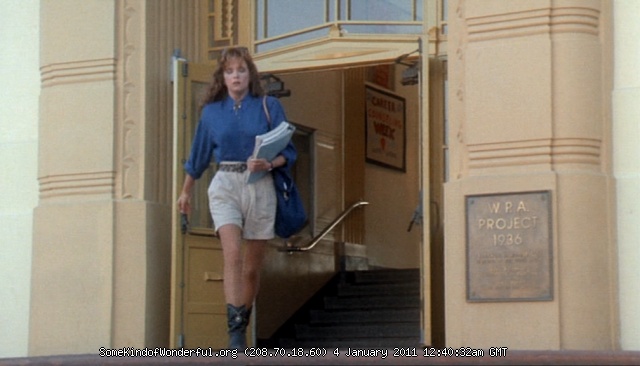
SHORTS! I once was at a poetry reading and I saw a woman wearing shorts with cowboy boots. Maybe she wasn’t wearing the boots, maybe I’m just putting the boots in there to make the shorts weirder than they already were. To clarify, the shorts weren’t weird in a specific way, and it was appropriate to wear shorts that day (considering it was 100 degrees out), they were just weird because shorts are weird in almost all circumstances.
Sometimes l cut off a pair of jeans and bum around the house in them. Sometimes I walk down to the trash shoot in them.
But generally speaking, I take an anti-short stance [for many years I didn't, and looking back at pictures, it's really too bad].
I would especially take this stance if I were giving a reading. If I had to wear shorts to a reading, like if a reading series required all readers to wear shorts, I'm pretty sure somebody would have to take me to the hospital afterward. In short, in shorts I feel naked and in my pajamas at the same time.
Shorts are, in a word, undignified. I said this to two guys at work and they were outraged, like “Don’t EVEN call my mom undignified. YOU ARE THE ONE WHO IS UNDIGNIFIED IN YOUR PANTS.”
What can I say? Regular non-artsy dudes love a good short.
The only time you will ever see some indie artsy fellow wearing shorts is at the gym. And then they will pair it with a t-shirt with the name of an obscure band or an ironic picture of a wolf howling at the moon, as if to say, “These weights that I am lifting are not that heavy. But that is because I am alternative.”
SCARVES! This same poet the next time I saw her—I don’t know her but she seemed perfectly nice--was wearing a scarf. But not a winter one. One like French people wear. Again: weird. That is for French people, scarves with no thermal purpose.
Ms. Gainsbourg?
Excuse me, Ms. Gainsbourg?
Oh, sorry, ma’am, I forgot my glasses at home.
AND UNFORTUNATELY I AM GOING TO HAVE TO ASK YOU TO REMOVE YOUR SCARF.
Granted, Charlotte Gainsbourg could wear shorts and cowboy boots and a giant scarf all together at one time and she would look so amazing, you would hurt inside, like I WANT TO BE YOU. I WANT TO SING LEMON INCEST WEARING THAT OUTFIT.
1. What do you splurge on?: I got crushes on scarves! And boots, too, because I love awesome old-leather boots.
2. A fashion rule you never break: Being classy: it's the best if you understand classy!
I am guilty of not understanding classy and having worn scarves of the not-for-warmth variety. I actually had a scarf from France that I bought it in a tourist shop at St. Michel. At the time it made me feel “I am sophisticated and worldly--as this scarf very clearly expresses.” I thought it looked so good, sometimes I would transfer it up to my head and wear it David Foster Wallace style so the Frenchness would get a little closer to my brain. Also, kerchiefs were in style in Indiana back then and I was stylish, that was just who I was in my DNA, so it wasn’t really up to me.
I have friends who wear scarves and they look great and I don’t judge them for doing so. I actually don't mind people in scarves if I know them. But I would not like to meet a person for the first time wearing a scarf. It would be confusing for me.
NEVER HAPPENED THIS WAY Do you ever watch a movie and while you’re watching it, you’re thinking, This outfit is so strange and bad, even for this time period, but when people watch this movie in twenty years, they will mistakenly think, “Welp. That was the 80s for ya!”? I am referring specifically to the short/boot combo in SOME KIND OF WONDERFUL:
And the prom dress in FOOTLOOSE:
[Okay, so the dress might have been bad because her parents were religious, but still: No.]
I vividly remember thinking, “Somebody should write a short note and put it in the archive so that our successors will know the wearings of their ancient peoples, like: “That outfit is not “of a time.” It was always terrible and embarrassing.”